1) Objective: Create and research materials to be used during sessions to stimulate cognition and language, most commonly having to do with auditory processing.
Activities and Resources:
o Come up with new materials to go along with lesson plans related to the story books: “Corduroy”, “The Napping House”, and “From Head to Toe”.
o Research activities and online resources.
o Observe professionals and co-facilitate lessons to see how these resources can be used in session to benefit clients.
Evidence:
o Include an overview of auditory processing disorder and a few examples of the created materials in my portfolio and explain how they are used in session and how they can benefit the client.

In order to come up with exercises to implement in session I had to do some research on what an auditory processing disorder was. From this information I created activities and materials that I thought would positively contribute to the session as well as help to aid the child's improvement.
What is an Auditory Processing Disorder?
“Auditory processing refers to how the brain perceives and interprets sound information. Sound information refers to things we hear, like others’ voices, traffic, alarms, etc.”[i] In order to interact with others and complete different tasks it is important to be able to listen to others and process different sounds. Another important aspect of auditory processing is sequencing of events.
Children with an auditory processing disorder have trouble in a variety of areas such as: auditory awareness, auditory discrimination, auditory identification and auditory comprehension. “Auditory Awareness includes the ability to detect sound, where as auditory discrimination is the ability to hear differences between sounds. Other areas include auditory identification which is the ability to attach meaning to sounds and speech and lastly, auditory comprehension is the ability to understand longer auditory messages”.[ii]
All of these skills develop in order from the “easiest to the most difficult”[iii], but the working together of these areas is essential. Sequencing issues are most related to auditory comprehension. Since understanding is difficult they may have trouble with things such as oral speech and stories. In these situations children are required to process the information, understand it, retain it, and then organize it, which is something that results in difficulty for the child. Another large issue is the environment the child may be in. When the child is in a noisy environment with a lot of background noise, they have trouble filtering out the important information.
What are the symptoms of possible auditory processing difficulty?
Children with auditory processing difficulty can have many symptoms, some having more than others. Children typically have normal hearing and intelligence, but however, they have also been observed to have some of the following symptoms: they have trouble paying attention to and remembering information presented orally, have problems carrying out multi-step directions, have poor listening skills, need more time to process information, have low academic performance, have behavior problems, have language difficulty (e.g., they confuse syllable sequences and have problems developing vocabulary and understanding language), and have difficulty with reading, comprehension, spelling, and vocabulary”. [iv]
Possible treatment methods:
Many Speech Pathologists use exercises that improve “language building”[v] which help to increase their ability to learn new words, therefore helping increase their language base. Another method is “auditory memory enhancement”[vi] which is a procedure that reduces information so it is more basic and easier to comprehend.
Over the course of my undergraduate work in the communicative disorders department at URI, I have had the opportunity to learn about auditory processing disorders and how it can effect communication. It has always been a topic of interest for me and I have now been able to do some additional research that has been included above.
The
next section will display materials I have used in session as well as how they
have worked in session. There are many other materials that I have used, but
since they are similar to the categories I will display, I have only selected a few examples to illustrate.
[i] Johnson, Clint M., and Julie A. Daymut. "Look, Listen....and Sequence!" Super Duper Publications, 2010. Web. 1 Mar. 2011.
[ii] Johnson, Clint M., and Julie A. Daymut. "Look, Listen....and Sequence!" Super Duper Publications, 2010. Web. 1 Mar. 2011. <http://www.superduperinc.com/handouts/pdf/286_SequencingAndVisual.pdf>.
[iii] Johnson, Clint M., and Julie A. Daymut. "Look, Listen....and Sequence!" Super Duper Publications, 2010. Web. 1 Mar. 2011. <http://www.superduperinc.com/handouts/pdf/286_SequencingAndVisual.pdf>.
[iv] "Auditory Processing Disorder in Children." National Institute on Deafness and Other Communication Disorders [NIDCD]. Feb. 2004. Web. 01 Mar. 2011. <http://www.nidcd.nih.gov/health/voice/auditory.html#aud_07>.
[v] "Auditory Processing Disorder in Children." National Institute on Deafness and Other Communication Disorders [NIDCD]. Feb. 2004. Web. 01 Mar. 2011. <http://www.nidcd.nih.gov/health/voice/auditory.html#aud_07>.
[vi] "Auditory Processing Disorder in Children." National Institute on Deafness and Other Communication Disorders [NIDCD]. Feb. 2004. Web. 01 Mar. 2011. <http://www.nidcd.nih.gov/health/voice/auditory.html#aud_07>.
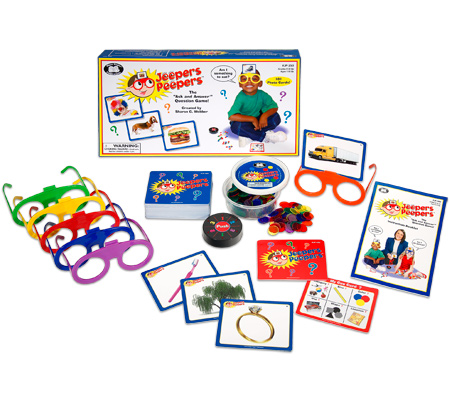 |
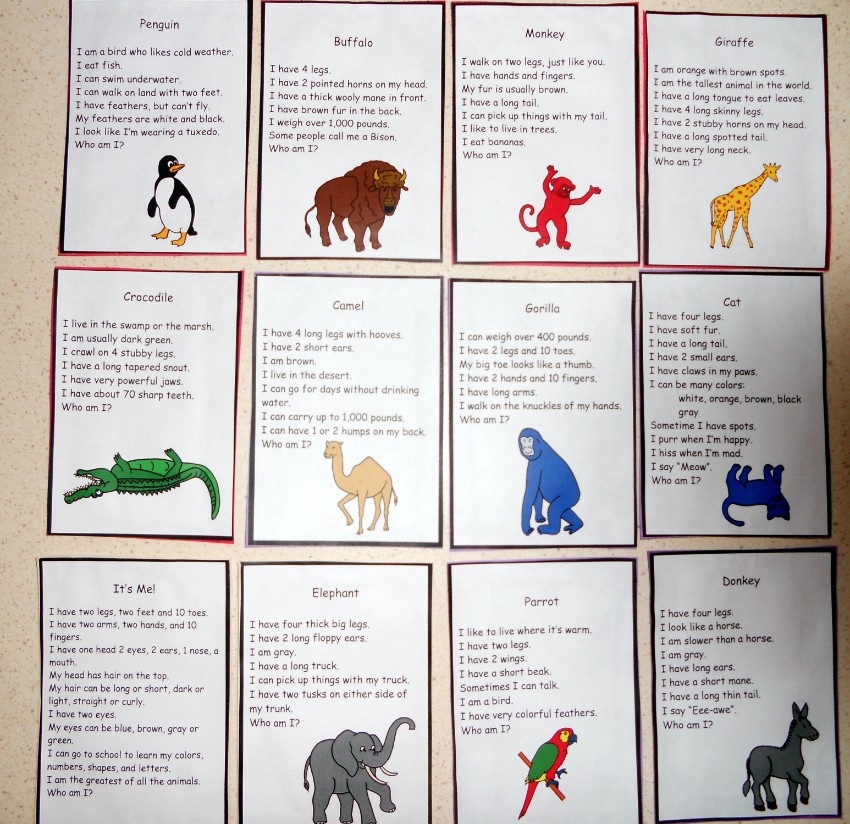
The first concept that I worked on was listening skills and developing vocabulary. I created one exercise to go along with a story and also used a game that my supervisor had purchased called Jeepers Peepers. The materials that I had created were picture cards of animals from the story with clues. We would all take turns giving clues for the animals from Eric Carle's book "From Head to Toe". I would give the clues to the child and she would have to use her listening skills to figure out what animal I was talking about. I took this concept a little further with the game Jeepers Peepers. To play this game everyone wears glasses and they place a picture card on top facing away from them. The other players have to give clues until they guess the picture. This was more difficult because the clues were not already listed and it required more vocabulary. The child I worked with did very well she had great vocabulary and did well at guessing. For example, when given the picture of a bride she described her as "a girl who marries someone, she has a beautiful dress, she has flowers, and she marries daddy". We participated in these activities frequently and I really saw an improvement in her listening skills, as well as her word retrieval and vocabulary.
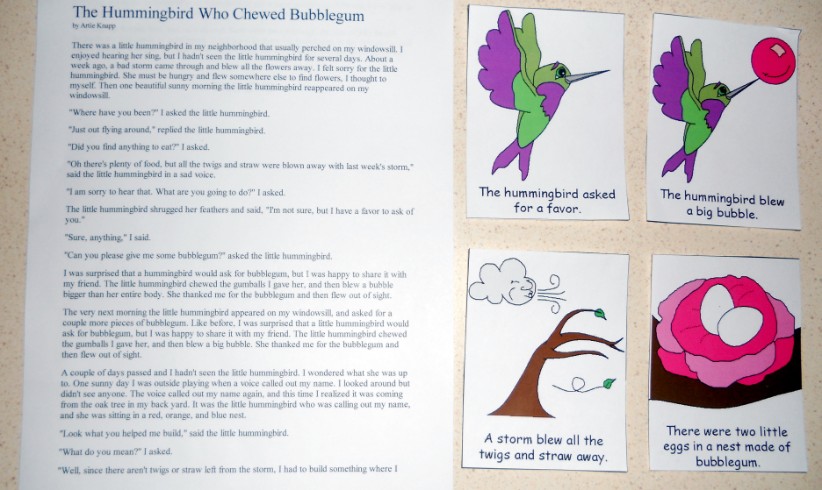
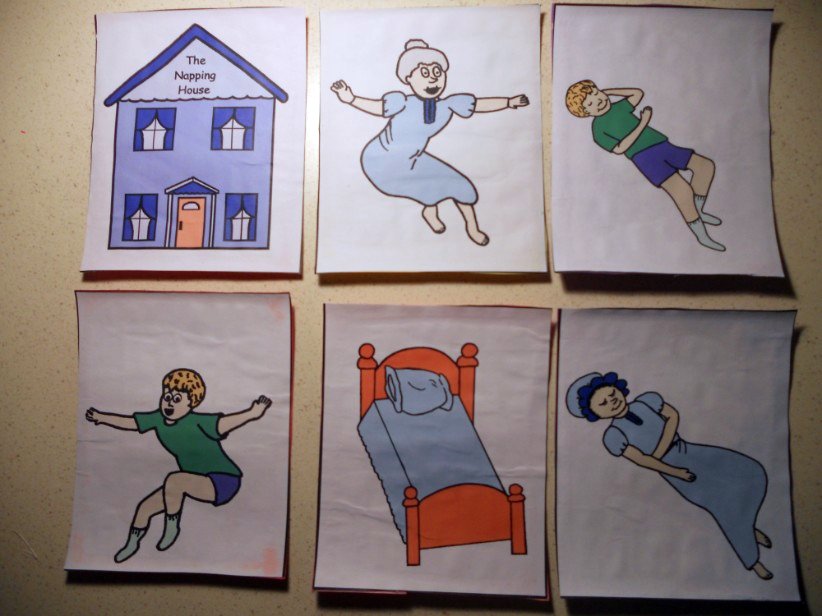
The second activity that I implemented in session was sequencing. I had created two activities, one with picture cards that went along with the story "The Napping House" and the other to a few short stories that I found online, one being "The Hummingbird who Chewed Bubble Gum". The short stories were easier because they had less sequencing, but if I read the story to her without the pictures in sight she had more difficultly recalling what had happened. I would have to go back and reread that section of the story and I found that it helped if she closed her eyes to listen. "The Napping House" was expected to be more difficult because the book sequences the order that everyone went to sleep and then when they woke up. I thought that this would be more difficult for her to sequence, but she did a wonderful job. By doing these sequencing activities every few days I saw an improvement, even in her imaginative play when we would give her multi-step directions to do in order.
Evidence #3:
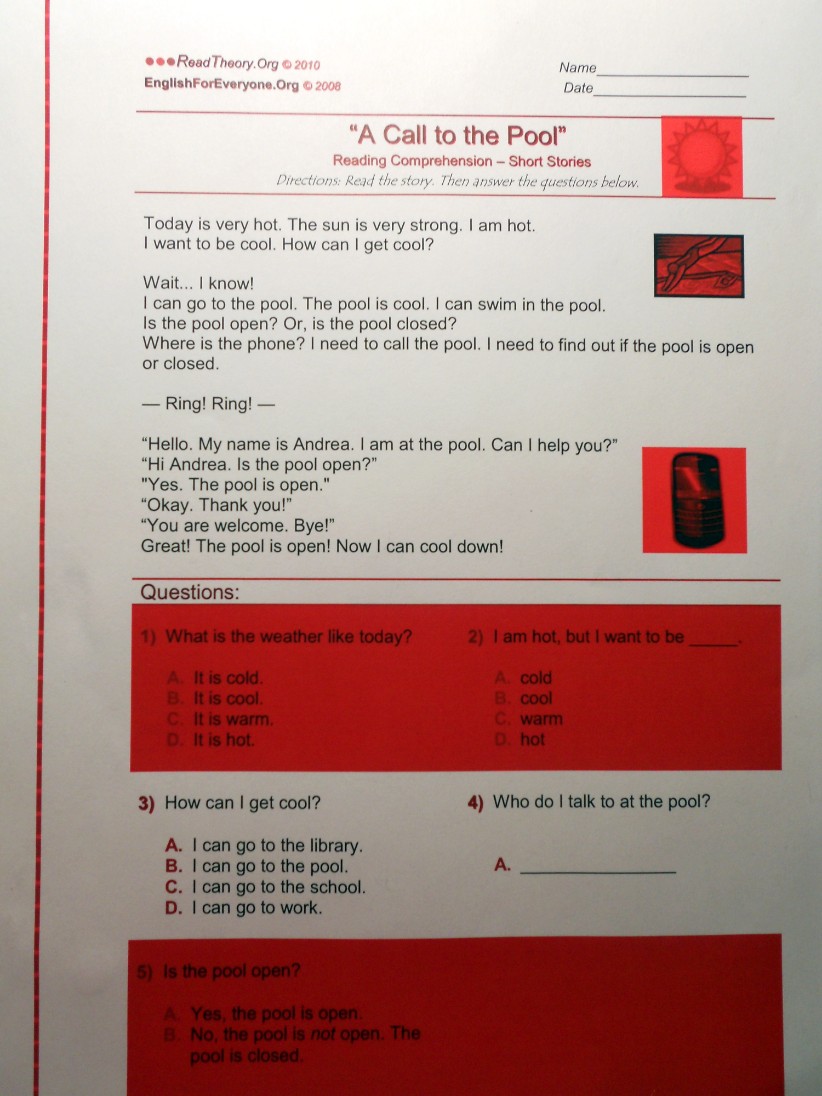
The third strategy that I worked on in session was listening comprehension, as well as memorization and repeating. The first activity was a short story that had comprehension questions to answer. The story and the questions were given orally. I found that when it came to people's names as well as multiple term answers she had trouble answering correctly. If I asked her the questions while reading the story she did a lot better than if I asked her all of them after. Also, when asking her questions pertaining to the names of people in the story she could not answer right away, but if she covered her eyes and thought about it she always answered correctly. One other exercise that we tried was memorizing and retelling jokes. She really loved telling jokes so I turned something that she enjoyed into an activity for session. Prior to each session I would look up three jokes for us to work on. For example we used:
What do you get when you put three ducks in a box? A box of quackers.
What do you say to a cow that crosses in front of your car? Mooo-ve over.
What did the egg say to the other egg? Let's get cracking.
Why do cows have bells? Because their horns don't work.
Where do cows go on a Saturday night? To the moo-vies!
What do dogs eat at the movie theater? Pup-corn
Why did the banana go to the Dr? Because it was not peeling well.
Every session I would tell her a few jokes and help her memorize them so that she could tell them to her mother after the session. She really enjoyed this, but had difficulty with the order of the words and even more trouble with the question words. She would mix up what and why. When helping her memorize I would break the joke down into parts and use visual aids to help. For example I would use one toy car to symbolize "what did the egg say" and the second car to symbolize "to the other egg" and show her how to put the two together in order. She did much better with the visual aids.
In conclusion the information that I have learned academically in Disorders classes, as well as through my research has helped me to create materials to implement into sessions. I believe that the exercises helped, but they were also enjoyable. She loved playing Jeepers Peepers and anything else that involved stories. Being able to work one-on-one with her and demo my materials helped me to change what I was doing to cater more to her needs. This was truly an experience that let me be more hands on so that I could learn through doing instead of the constant academic coursework. This evidence has shown how I can be creative and still also find ways to implement fun activities into sessions that aid the child's development.
