2)
Objective: To learn techniques in oral motor therapy for working with children.
Activities and Resources:
o Shadow or observe professionals performing the therapy.
o Use internet resources or literature for information research.
o Conduct informational interviews with co-workers or professionals.
o Review DVD's or streaming video of the techniques.
Evidence:
o Include in my portfolio a pamphlet I created which will detail the oral- motor therapy techniques for working with children.
o Provide case studies of techniques used when working with my clients.
A
second objective of mine was to learn techniques in oral-motor therapy for
working with children. I had observed my supervisor's techniques during session, as well as
researched methods of oral motor therapy and had read a lot about its
controversy in the Speech-Language Pathology field. Throughout the semester I
had witnessed these techniques truly work for many children. I had learned how
the mouth is a muscle that must be strengthened in order to support the other
articulators. Just like trunk stabilization is important for the disassociation
of your limbs, mouth strength is important for the disassociation of your
tongue and other means of intelligible speech.
I learned a lot from my research and the information I found was information that I had not learned in my academic classes. The University of Rhode Island does not teach oral motor therapy, so all of this information was new to me. These techniques had taught me a lot about the mouth, as well as what is new in the speech community. Being able to connect my research with clients taught me a lot about how the techniques are used in session and I saw how they worked on children.
What is Oral- Motor Therapy?
Oral motor treatment is a type of therapy that is used to “address sensory processing, as well as disassociation, grading, direction timing, and coordination of mouth movements for eating, drinking, speaking, and other mouth activities.” [i] The therapy includes the jaw, cheeks, lips, tongue, and all other articulators. Its goal is to increase “coordination and stamina of the jaw, lips, and tongue.” [ii] In order for a person to speak properly or eat efficiently, they must have strengthened and well trained muscles to execute the task.
Oral motor therapy works by exercising the muscles in your mouth. A normal mouth needs no practice because daily tasks such as speaking and eating provide enough exercise. This exercise “will improve the ability to use them with greater stamina, speed, accuracy and control.”[iii] When it comes to people who have some sort of disability, these muscles are not exercised each day and therefore the function and coordination of these muscles decreases.
People with an oral motor speech disorder have compromised accuracy and efficiency of speech. “To improve the accuracy of speech it is important to practice effective oral motor exercises to increase neuromuscular coordination.”[iv]
What are some symptoms of an Oral Motor Disorder?
Common symptoms include the following and can improve with daily exercise.[v]
Poor strength and coordination of the lips, tongue, and jaw.
Poor speech clarity ("muddled" speech)
Drooling
Poor muscle tone in the face (muscles appear to be "sagging")
Difficulty with chewing and swallowing (feeding difficulties)
Voice changes - speech sounding hoarse, nasal, or soft
Unable to perform coordinated oral movements
Some speech disorders that relate to oral motor difficulties include: Verbal Apraxia, Oral Apraxia, and Dysarthria, as well as Aphasia. Oral and Verbal Apraxia can appear together, but Oral Apraxia does not include the act of speaking.
Verbal Apraxia: “Verbal Apraxia is a disorder that affects voluntary muscle movement for speech. Although the jaw, tongue, and lip muscles have no muscle weakness, a Verbal Apraxic will have tremendous difficulty speaking because they cannot move their speech muscles in proper sequence.” [vi]
Oral Apraxia: “Oral Apraxia is the inability to carry out oral muscle movement on command. For example, if you asked an individual with Oral Apraxia to blow a kiss they would experience difficulty making the proper oral movements.” [vii]
Dysarthria: “Dysarthria is a neurological disorder that impairs the oral muscles. It can include low muscle tone and/or muscle weakness, however other types demonstrate characteristics such as spasticity, Ataxia, increased muscle tone, and fluctuating tone.”[viii]
The Oral motor Controversy
The whole controversy with Oral Motor Therapy is that it is not proven to work so the American Speech Language and Hearing Association does not support it. Oral Motor Therapy is a way to “strengthen the muscles of the mouth and promote sensation in the mouth so that feeding and speech can be treated”.[xi] Many Speech Pathologists believe that if they can improve the strength of the jaw and facial muscles that can lead to more intelligible and clearer speech, as well as help with swallowing and feeding issues. The controversy is that it is believed that not a lot of muscle strength is needed to speak and if there is already an oral motor planning issue, it is due to the brain's ability to achieve the task.
The argument for oral motor states that “to ignore a child's ability to recognize their mouth and the movements it makes doesn't make sense. Many have found that the better a child can motor plan oral and verbal movements, as well as increase the overall awareness of their mouth, the more success is seen with their speech." [xii]The child first needs to be able to create the movements so that speech can improve later.
Oral Motor treatment is something that is still being researched, but it has helped a lot of children improve their skills. Even though it is not supported by the American Speech Language and Hearing Association it is still being researched and can work. Every person is different and whether or not the treatment works for one child it may not work for the other. That is why therapy is specific to the patient.
Evidence #1
What tools and techniques are used?
Speech Pathologist may use tools such as different strength chewy tubes, z-vibes with different tips, sticks, whistles, and massagers.
Chewy Tubes: Chewy tubes are used to strengthen the muscles of the jaw while chewing. They come in multiple sizes and shapes, but the yellow and red ones work efficiently. The tube is inserted in the mouth on the back teeth of the patient in which they bite down on. Between bites make sure to pull the tube out and reinsert it so that the patient is opening up largely before biting down again. 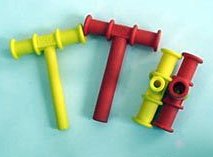
Lip Exercises: Lip exercises such as “Lip retraction and Lip protrusion” can be done to help loosen up the lips. For patients who talk without using their lips this is a way to get their lips moving. To gain range of motion you can have them “smile for up to five seconds and then relax and repeat five times,” [ix] this practices lip retraction. For lip protrusion “smile then pucker the lips in an exaggerated fashion, relax and repeat five times.”[x]
Jaw Exercises: Jaw grading bite blocks can be used to help with the range of movement of the jaw. The bite blocks come in different sizes ranging from thin to think and the objective is to go through the sticks and have the patient bite down on them. Hold the block in their mouth on their back teeth and have them bite down tight while you try to pull the stick out. This technique works on the range of motion of the mouth due to the different thicknesses, as well as strengthening the jaw.
|
Z-Vibes and Massagers: These are used for more sensory exercises. The tip of the z-vibe may be rolled under the patients lip and used to massage “c”-shaped arches on the inside of the patients cheek. They also come with special attachment tips to rub the sides of the tongue or use the pointed tip to point to the roof of the mouth so they can practice tongue elevation. 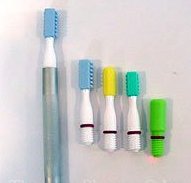
Tongue Exercises: Tongue
tip elevation is a good exercise for patients that have trouble raising their
tongues for a /l/ sound. With a Cheerio you can place it on the roof of their
mouth and have them lift their tongue to hold it there for a few seconds. This
helps strengthen their tongue, as well as have them practice the motor planning
of moving it there. Also, you can use Clicks to help dissociate the tongue
from the jaw. Have the patient bite down on a stick so that their jaw does not
move and then have them click their tongue making a noise without the movement
of the jaw. If they can properly do this exercise, they can move their tongue
without the help of their jaw. 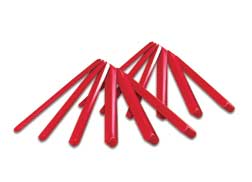 |
Evidence #2
All of these oral motor tools above have been used in sessions at my internship site. Chewy Tubes are used at every session no matter the age of the child. I have seen children start off not even allowing the chewy tubes near their mouths and then progress to chewing on their own. The more repetitions that are done the more strength that is gained. I had observed one boy who came into session and had no words and did not move his jaw or tongue. He had many motor planning problems and was diagnosed as Apraxic. After over a year of oral motor therapy he now dissociated his tongue from his jaw because of the tongue tip elevation exercises; he can now move his tongue on his own and properly position it. He also used the bite blocks to hold between his teeth and make a clicking noise, this also helped dissociate his tongue. From these exercises he has built a very large vocabulary. We had been working on the last step, which was moving his lips to make the words sound more intelligible.
Evidence #3
The first case described motor planning which is only one component of oral motor; the other is sensory. The z-vibe and massager are used inside the mouth to create sensation. After repetition of the vibration in the mouth, sensation is occurred which elicits movement. One case that I saw was with a boy who had very large cheeks and would drool constantly. Once he had repetitive sensory stimulus he began to stop drooling. Since the vibration helped him gain sensation in his mouth he could feel the drool pooling up in his mouth and he would swallow it.Oral motor is also used to increase sensation and is important in children with feeding issues. The vibration gives them sensation in their cheeks which allows them to feel food that they may be pocketing. It also eliminates choking on left over food.
[i] Gruenberg, Brian. "Effective Oral Motor Exercises: Your Source of Information ..." Improve Your Speech and Language Skills: Effective Exercises You Can Use at Home. Communication Scripts, Inc., 2006. Web. 05 Apr. 2011. <http://www.speech-therapy-on-video.com/oralmotorexercises.html>.
[ii] Gruenberg, Brian. <http://www.speech-therapy-on-video.com/oralmotorexercises.html>.
[iii] Gruenberg, Brian. <http://www.speech-therapy-on-video.com/oralmotorexercises.html>.
[iv] Gruenberg, Brian. <http://www.speech-therapy-on-video.com/oralmotorexercises.html>.
[v] Gruenberg, Brian. <http://www.speech-therapy-on-video.com/oralmotorexercises.html>.
[vi]Gruenberg, Brian. <http://www.speech-therapy-on-video.com/oralmotorexercises.html>.
[vii] Gruenberg, Brian. <http://www.speech-therapy-on-video.com/oralmotorexercises.html>.
[viii] Gruenberg, Brian. <http://www.speech-therapy-on-video.com/oralmotorexercises.html>.
[ix]"Exercises for Swallowing." UL-Lafayette Computing Support Services. Web. 05 Apr. 2011. <http://www.ucs.louisiana.edu/~ncr3025/roussel/codi531/oralexercise.html>.
[x] "Exercises for Swallowing." UL-Lafayette Computing Support Services. Web. 05 Apr. 2011. <http://www.ucs.louisiana.edu/~ncr3025/roussel/codi531/oralexercise.html>.
[xi] "PediaStaff Resources - Oral Motor Therapy & Debate." PediaStaff - Pediatric and School-Based Therapy Jobs - Speech Language Pathology, Occupational Therapy, Physical Therapy and School Psychology Jobs. Web. 14 Feb. 2011. .
[xii] Bruno, Stephanie. "Early Intervention Speech Therapy: The Oral-Motor Debate." Health Care POV. Web. 14 Feb. 2011.
